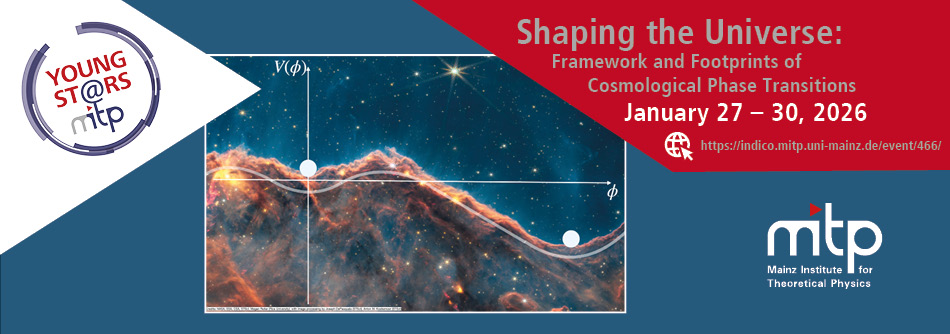
This workshop will explore various aspects of cosmological phase transitions, from the theoretical framework to BSM applications to precision predictions and observability prospects. It will be divided into four subtopics, with each day dedicated to one topic:
PHASE TRANSITIONS AS A MODEL-BUILDING TOOL
Setting the framework for PTs to address SM shortcomings is the first step towards the advancement of the field. The focus will lay on universal aspects of PTs, specifically on thermal corrections, gravitational effects and on general constraints e.g. on modified cosmological histories or late PTs.
PHASE TRANSITIONS AS A BSM PLAYGROUND
PTs are predicted in many BSM extensions; their strength and symmetry-breaking patterns could lead to the formation of bubbles and topological defects. We will explore how they can naturally provide new opportunities for baryogenesis, leptogenesis, dark matter production (e.g. axions) and more.
MODELLING OUT-OF-EQUILIBRIUM DYNAMICS
Developments in numerical computations are essential in order to obtain precise predictions of cosmological relics such as gravitational waves, dark matter and primordial magnetic fields. This session will focus on the current status of theoretical modelling and (lattice) simulations of phase transitions, defects and bubble-wall propagation in a plasma.
PROBING PHASE TRANSITIONS
The distinct imprints of cosmological PTs will be explored, addressing the prospects of next generation space- and ground-based detectors. Particular attention will be given to gravitational waves signals (LISA, PTAs, ET, LiteBIRD), and to constraints on intergalactic magnetic fields from non-observation of gamma-rays from blazars (Fermi-LAT, HESS), as well as to complementary laboratory probes on PT dynamics including table-top quantum-many body systems.