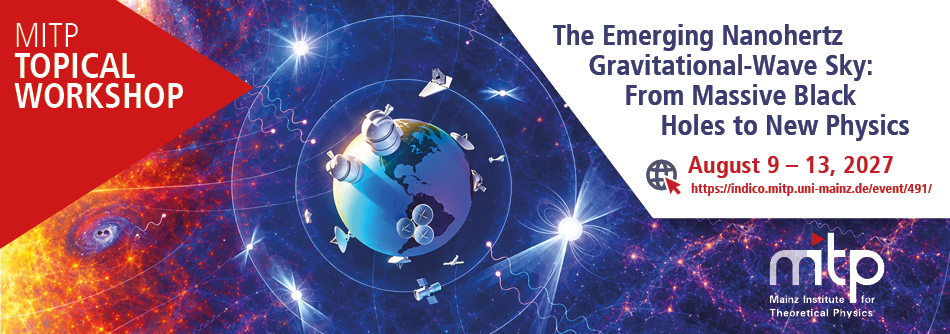
In recent years, pulsar timing array (PTA) collaborations around the globe have provided growing evidence for a nanohertz gravitational-wave background, marked by the characteristic Hellings–Downs correlation pattern. This progress represents a major milestone in gravitational-wave science with broad impact across astrophysics and fundamental physics. Rapidly improving data sets are expected to soon surpass the 5-sigma discovery threshold and enable more precise spectral characterization, as well as possible evidence for anisotropies or individually resolvable sources. Capitalizing on this pivotal moment, this workshop will convene leading experts to address the most urgent scientific questions in this field, and help define a future roadmap of PTA gravitational-wave research.
The workshop will focus on key open questions raised by the emerging PTA signal, in particular that of the origin of the gravitational-wave background, with the two leading interpretations focusing on either a cosmic population of supermassive black-hole binaries or new-physics processes in the early Universe. Beyond this core issue, we will explore the broader scientific potential of PTA observations, including connections to multimessenger astronomy through electromagnetic counterparts of candidate binaries, constraints on deviations from general relativity, and potential signatures of dark matter. The workshop will also critically assess the robustness of current measurements of the background spectrum, the impact of pulsar noise modeling, and the implications of possible detections of anisotropies or resolvable sources. Overall, the workshop will provide a timely synthesis of the field, evaluate the status of open questions, and delineate the top science priorities for the next phase of nanohertz gravitational-wave research.
Choose timezone
Your profile timezone: